
Owner Operator vs Motor Carrier: Compliance Responsibilities Explained
In the trucking industry, the terms owner operator and motor carrier are often used interchangeably, but they actually refer to two different roles with different regulatory responsibilities.
Understanding the difference is critical because compliance responsibilities depend on who holds the operating authority and DOT number. Many new trucking businesses misunderstand this distinction, which can lead to serious violations or failed audits.
Regulations for commercial motor vehicles are enforced by the Federal Motor Carrier Safety Administration (FMCSA), which operates under the United States Department of Transportation.
This guide explains owner operator compliance rules, the responsibilities of motor carriers, and how these roles interact in the trucking industry.
What Is an Owner Operator?
An owner operator is an individual who owns their own truck and operates it as part of a trucking business.
Owner operators typically operate in one of two ways:
Independent Owner Operator
The driver owns the truck and operates under their own authority with their own DOT number.
Leased Owner Operator
The driver owns the truck but leases it to a motor carrier and operates under the carrier’s authority.
The compliance responsibilities for the owner operator depend on which model they operate under.
What Is a Motor Carrier?
A motor carrier is a company or individual that holds operating authority to transport freight.
Motor carriers are responsible for managing:
drivers
vehicles
safety compliance
regulatory filings
insurance coverage
Motor carriers must comply with safety regulations established by the Federal Motor Carrier Safety Administration.
This includes maintaining safety management controls and ensuring drivers operate within federal regulations.
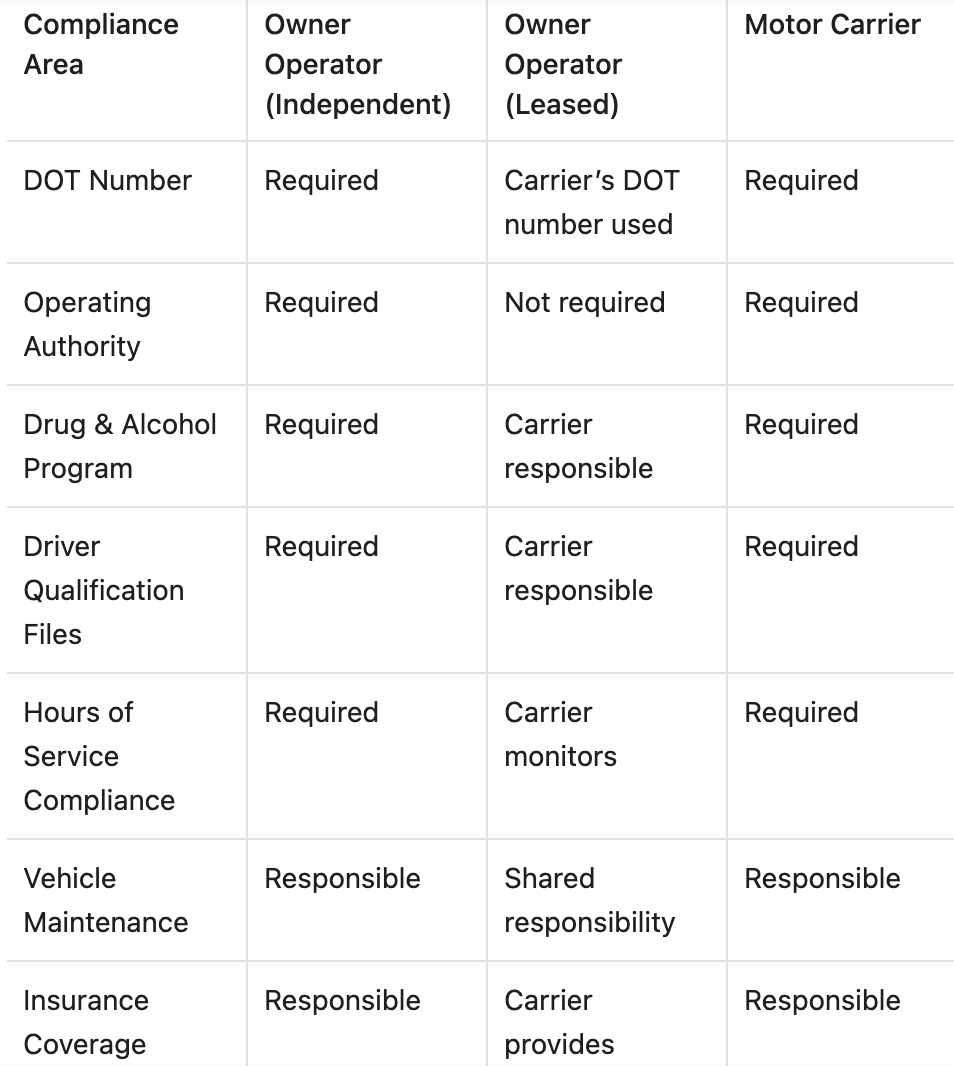
Key Compliance Differences Between Owner Operators and Motor Carriers
Understanding who is responsible for compliance depends on who holds the operating authority.
Owner Operator Compliance Rules
(Operating Under Your Own Authority)
Independent owner operators who operate under their own DOT number and authority must comply with the same federal regulations as a motor carrier.
These drivers are considered motor carriers themselves under federal law.
Compliance responsibilities include:
maintaining Driver Qualification Files
enrolling in a DOT drug and alcohol program
complying with hours-of-service regulations
maintaining vehicle inspection records
maintaining insurance coverage
updating the MCS-150 biennial report
Failure to maintain these records can lead to violations during DOT audits.
Owner Operators Leased to Motor Carriers
Many owner operators choose to lease their truck to a motor carrier and operate under the carrier’s authority.
In this arrangement:
the motor carrier assumes most regulatory responsibility
the owner operator becomes a driver under the carrier’s safety program
The motor carrier typically manages:
driver qualification files
drug and alcohol testing programs
safety management systems
compliance documentation
However, owner operators still maintain some responsibilities.
Compliance Responsibilities of Leased Owner Operators
Even when leased to a motor carrier, owner operators still have responsibilities related to safe operation of their vehicle.
These may include:
maintaining the vehicle in safe operating condition
completing driver vehicle inspection reports (DVIRs)
following hours-of-service regulations
maintaining valid CDL and medical certification
complying with company safety policies
The carrier is responsible for ensuring these rules are followed.
Motor Carrier Compliance Responsibilities
Motor carriers hold the majority of regulatory responsibility under Federal Motor Carrier Safety Administration regulations.
Motor carriers must ensure that all drivers operating under their authority comply with federal safety standards.
Major compliance responsibilities include:
Driver Qualification Files
Motor carriers must maintain complete files for every driver operating under their authority.
These files typically include:
driver application
CDL copy
medical certificate
motor vehicle records
safety performance history
annual driver review
Drug and Alcohol Testing Program
Motor carriers must maintain a compliant DOT drug and alcohol testing program.
This includes:
pre-employment testing
random testing pools
post-accident testing
reasonable suspicion testing
Drivers must also be registered in the FMCSA Drug and Alcohol Clearinghouse.
Hours of Service Compliance
Motor carriers must monitor driver compliance with Hours of Service (HOS) regulations.
Most carriers must also implement Electronic Logging Devices (ELDs) to track driver hours.
Vehicle Maintenance
Motor carriers must maintain records proving their vehicles are inspected and properly maintained.
This includes:
annual DOT inspections
maintenance records
repair documentation
driver vehicle inspection reports
Safety Management Controls
Motor carriers must establish internal safety systems to ensure regulatory compliance.
These systems help prevent violations and demonstrate compliance during audits.
Common Compliance Mistakes
Many trucking companies and owner operators misunderstand owner operator compliance rules, leading to preventable violations.
Common mistakes include:
assuming the carrier handles all compliance
failing to enroll in a drug testing consortium when operating independently
incomplete driver qualification files
missing maintenance records
hours-of-service violations
Understanding responsibilities clearly helps prevent these issues.
Why Compliance Matters
Compliance with federal regulations is essential for maintaining safety and protecting the trucking company’s operating authority.
Companies and drivers that maintain strong compliance programs benefit from:
improved safety ratings
fewer roadside violations
lower insurance costs
stronger relationships with brokers and shippers
Proper compliance also reduces the risk of costly DOT enforcement actions.
Final Thoughts
Understanding the difference between owner operator and motor carrier compliance responsibilities is essential for anyone entering the trucking industry.
Independent owner operators must meet the same regulatory standards as motor carriers, while leased owner operators operate under the carrier’s safety management system.
Knowing your role and responsibilities helps ensure compliance with federal regulations and keeps your trucking business running smoothly.
Need Help Managing Trucking Compliance?
Managing DOT compliance requirements can be complicated for both motor carriers and independent owner operators.
A Plus Compliance Group helps trucking companies and owner operators stay compliant by managing:
driver qualification files
DOT drug and alcohol consortium enrollment
compliance documentation
safety audit preparation
ongoing compliance monitoring
Working with a compliance partner can help ensure your trucking operation remains compliant and focused on running your business.